Why Burberry's Name Does Not Stand Next to Hermès and Chanel — Even with 168 Years of Heritage
Brand Architecture · Heritage · Symbolic Authority
Heritage does not create luxury authority. Hermès and Chanel prove it. Burberry's 168-year history proves the opposite. Understanding why is the most important lesson a luxury founder can learn.
The Question Nobody Asks Directly
Ask anyone to name an ultra-heritage luxury brand and you will hear the same two answers: Hermès. Chanel. Occasionally you will hear Dior or Louis Vuitton. You will rarely, if ever, hear Burberry — not because people do not know the name, but because Burberry does not occupy that register in the consumer's mind.
This matters enormously. Heritage is routinely cited as one of the foundational pillars of luxury brand value. Kapferer places it explicitly within the luxury brand identity prism. BCG and Bain both treat founding-era credibility as a structural asset. By that logic, Burberry — founded in 1856, predating Chanel by over five decades and established just fifteen years after Hermès in 1837 — should sit comfortably inside the highest tier of brand perception.
It does not. And the reason it does not is the most instructive case study available to any founder building a brand with genuine long-term ambitions.
Consider who is confidently positioned without running meme campaigns, viral social content, or aspirational-accessibility marketing. Hermès does not need to be funny online. Chanel does not need to reach you. Loewe, despite its 1846 founding, has spent years rebuilding the symbolic architecture that makes heritage feel like authority rather than age. Jacquemus, founded in 2009, is perceived by many consumers as more emotionally premium than Burberry — a brand 150 years older. That inversion is not an accident. It is the result of a specific and diagnosable failure.
What Actually Happened to Burberry
The decline of Burberry's symbolic authority is not a recent event. It is a cumulative story with roots stretching back decades, punctuated by one catastrophic moment in the early 2000s, followed by a recovery that was always structurally incomplete.
Burberry's signature check — introduced as a trench coat lining in the 1920s — became through licensing one of the most replicated patterns in fashion. By the 1990s, the check appeared on everything: dog leads, baby carriages, caps, scarves, luggage. Twenty percent of all Burberry products carried the pattern. Licensing arrangements with 23 operators across the world meant the brand had, effectively, handed its most recognisable asset to outside entities with no obligation to protect its cultural meaning.
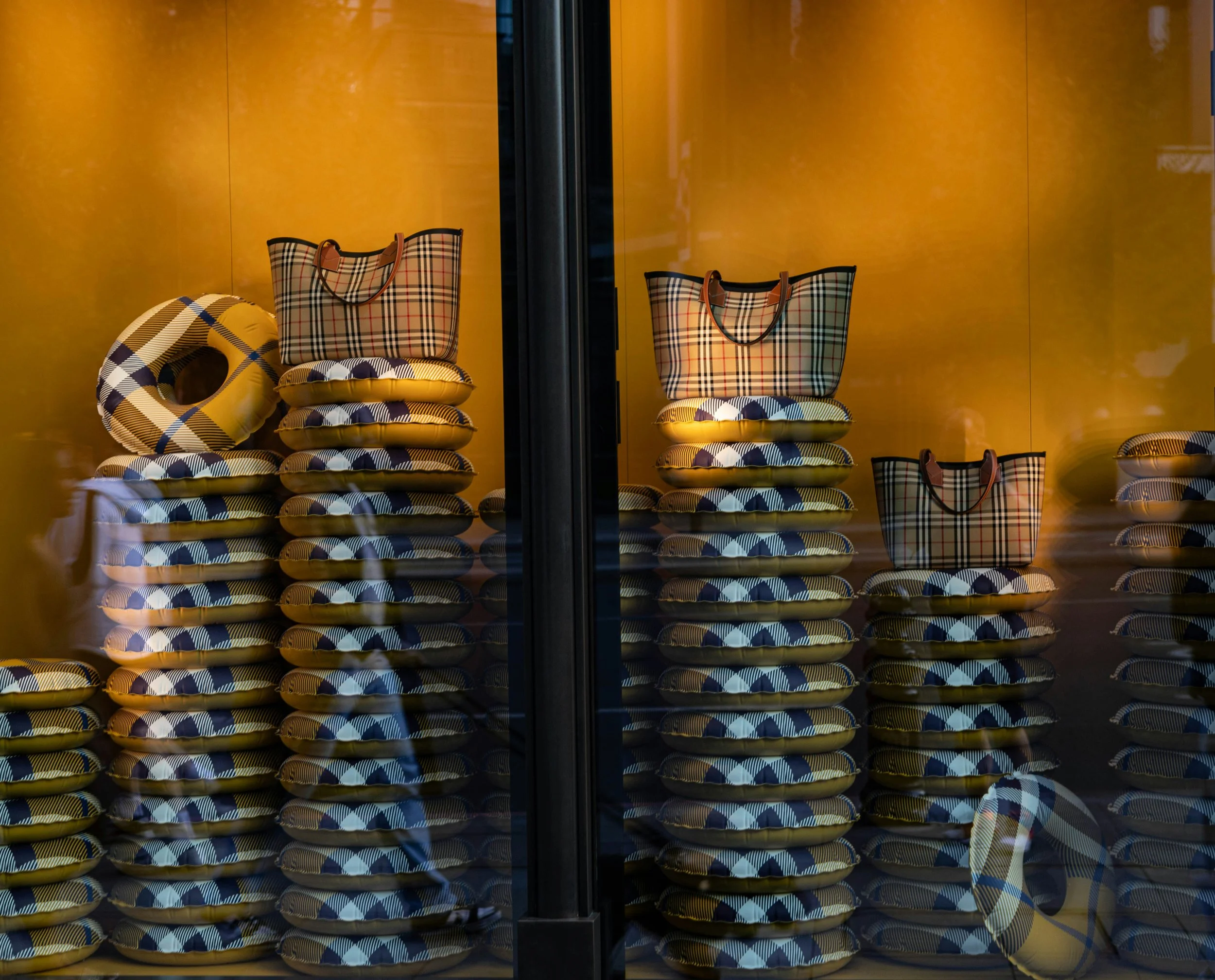
The result was predictable. By the late 1990s, the check had been absorbed into what British media labelled chav culture, a working-class subculture associated in popular discourse with antisocial behaviour and football hooliganism. The pattern appeared in equal measure on counterfeit goods and on the most visible tabloid figures of the era. UK pubs and nightclubs began formally banning Burberry check at the door. Harvey Nichols and Selfridges quietly removed the brand from their floors. The check, which should have been the brand's most potent symbol of distinction, had become a liability.
Data Reference
In 2002, the check appeared on 20% of Burberry's product range. By 2004, that figure had been cut to under 5%, a calculated act of subtraction designed to restore symbolic control.
Burberry's global market share in luxury apparel fell from 3.2% in 2015 to 2.7% in 2023, per Euromonitor International, even after years of attempted repositioning.
By July 2024, Burberry had issued three consecutive profit warnings in a single year and suspended its dividend. The company's market capitalisation fell from a peak of nearly £10 billion to approximately £4.2 billion.
Creative direction did not stabilise the brand either. Four creative directors in a decade, Bailey, Tisci, then Lee, produced a visual incoherence that made it impossible for consumers to form a stable emotional relationship with Burberry's aesthetic identity. Each reinvention implicitly communicated that the previous version was a mistake. In luxury, that is a statement no brand can afford to make repeatedly.
Meanwhile, the outlet store problem compounded every recovery attempt. Outlet sales accounted for over 17% of Burberry's revenue in 2024. The brand was simultaneously raising prices at full-price retail, some items increased by up to 20% in a single season, while products circulated at 30% to 60% discounts through off-price channels. That contradiction is not recoverable through marketing spend. It is structural damage to the brand's pricing architecture.
The Real Shift Underneath the News
The surface reading of Burberry's trajectory is a story about brand dilution, poor creative direction, and opportunistic discounting. Those things are real. But the deeper structural failure is something more fundamental: Burberry lost control of its symbolic territory, and was never fully able to reclaim it.
Hermès and Chanel have never had this problem, not because they have not faced external pressures, but because the architecture of their brand authority is not located in a single visual asset that can be replicated or degraded. Hermès' authority resides in craft mythology, vertical control, and deliberate unavailability. The Birkin is not desirable because it is recognisable. It is desirable because it is structurally difficult to obtain.
Chanel's authority resides in the Coco Chanel founder narrative, the couture heritage, and a distribution discipline so strict that the house avoids mass e-commerce for its fashion collections entirely, preserving the ritual of boutique access as part of the product itself.
Neither house has needed to make its symbol available to the mass market to build revenue. Both have understood, at an institutional level, that the moment you allow your symbol to circulate without gatekeeping, you have already begun the erosion. Hermès maintains no outlets. Chanel does not participate in end-of-season promotions. When inventory remains unsold, the strategic response is not discounting. It is destruction or controlled redistribution, because protecting the brand's price architecture is worth more than recovering sunk production costs.
This is precisely what Kapferer's framework predicts. True luxury brands build timeless icons, what he calls everlasting SKUs, that operate outside the fashion cycle and whose perceived value increases with time. Brands that enter the outlet-and-discount cycle are not luxury brands operating under pressure. They are fashion brands that borrowed the aesthetic codes of luxury without internalising its operating logic.
Why It Happened: The Three Pressures
Burberry's structural vulnerability can be traced to three converging forces that Hermès and Chanel, by design, do not share.
Ownership Structure and Profit Mandate
Burberry is a publicly listed company on the London Stock Exchange, subject to quarterly earnings pressure, shareholder expectations, and activist investor scrutiny. This structure creates an institutional incentive to prioritise short-term revenue recovery, including outlet expansion and licensing agreements, over the long-term discipline required to protect symbolic authority. Hermès remains majority family-owned. Chanel is entirely privately held. Both structures insulate brand decisions from the quarterly cycle. A CEO at Hermès who refuses to expand production to meet demand is protected by ownership with a generational time horizon. A CEO at Burberry who takes the same position faces a profit warning and a share price collapse.
The Nature of the Core Symbol
The check is a surface pattern, immediately recognisable, infinitely reproducible, and dependent on controlled distribution for its meaning. Once that control was surrendered through licensing, the symbol became democratic. Democracy is incompatible with luxury desirability. Hermès does not have this problem because its core symbols, the Birkin, the Kelly, the silk carré, are products whose manufacturing complexity and deliberate scarcity make wide reproduction structurally difficult. Chanel's quilting and camellia carry cultural weight that is harder to counterfeit precisely because they are embedded in a founder mythology that requires narrative, not just pattern recognition.
Geographic and Demographic Overextension
Burberry built its recovery in the 2010s significantly on Chinese consumer appetite for accessible heritage, a strategy that accelerated precisely as China's luxury consumers were maturing in their tastes. As the Chinese market contracted after 2021 and its most sophisticated consumers began demanding either ultra-deep craft credibility or domestic cultural relevance, Burberry's position was exposed. The brand had sold heritage without building the symbolic depth to sustain it at the highest price tier. Chinese consumers who had purchased Burberry as an entry point to heritage luxury moved upward, to Hermès, Chanel, and increasingly to culturally resonant domestic brands, and did not return.
Orisé Intelligence Takeaway
The Burberry case is not a story about one brand's failures. It is a diagnostic for the entire architecture of luxury authority, what builds it, what erodes it, and why the erosion is almost always invisible until it is already complete.
Burberry did not lose its position overnight. It surrendered it incrementally: through one licensing agreement, one outlet store, one creative reinvention, one profit warning at a time. And because each individual decision was defensible in the short term, the structural damage accumulated beneath the surface of quarterly reports until the brand looked up one day and found that consumers who wanted real luxury authority had simply stopped reaching for it.
The lesson is not that Burberry lacked heritage. It had more than most. The lesson is that heritage without symbolic governance, distribution discipline, and narrative coherence is simply age, and age, on its own, earns nothing.
