When the Brand Is a Person: Balmain’s Identity Vacuum After Olivier Rousteing
A 14-year spectacle era, a €30M → €300M leap, and what happens when celebrity architecture collides with heritage.
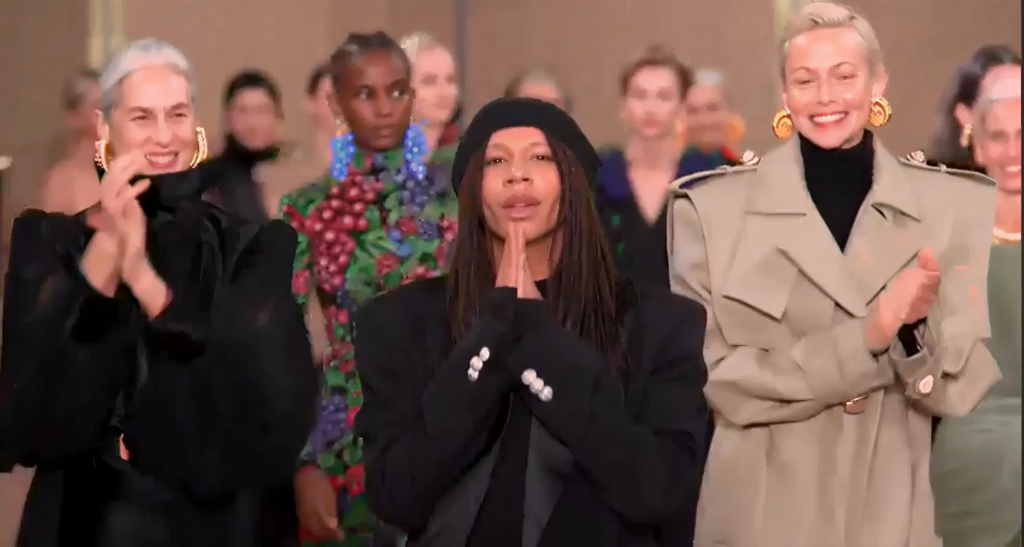
A runway finale scene from a Balmain fashion show. Models stand together on the catwalk, applauding as the show concludes, capturing the celebratory energy of the collection’s closing moment. ( from Balmain’s official YouTube runway show)
1. The Story Everyone Is Repeating (And Why It’s Not Enough)
Most summaries of Olivier Rousteing’s departure highlight the same key milestones.
Olivier joined Balmain at just 25 years old in 2011, becoming one of the youngest creative directors in modern Parisian fashion and the first Black designer to lead a French heritage maison across all categories. (Vogue Scandinavia)
During his fourteen-year tenure, Balmain experienced significant growth with revenues rising from approximately €30.4M in 2012 to around €300M last year. (Vogue Scandinavia) In 2016, the maison entered a new phase when Qatar-backed Mayhoola for Investments acquired the brand, placing it within a portfolio that also includes Valentino. (The Business of Fashion)
Most coverage then traces Rousteing’s cultural impact:
A strong celebrity ecosystem — from Beyoncé to the Kardashians
Large-scale runway spectacles that blended performance with couture
The creation of the “Balmain Army” as a community narrative
A shift toward digital-era visibility and global pop influence
The common conclusion is simple:
This marks the end of a major era, and the industry is now watching what Rousteing will do next.
This overview captures the essential facts — the milestones, the cultural influence, and the scale of transformation under his leadership.
Orisé’s role begins where the summary ends: translating these developments into their deeper strategic, psychological, and structural implications for the maison and the wider luxury landscape.
2. Balmain Under Rousteing: The Spectacle Luxury Operating System
To understand the risk Balmain faces now, you have to understand what Rousteing actually built:
Not just a collection style.
An operating system of spectacle luxury.
Balmain under his lead was:
Platform-native. Designed to be screenshotted, clipped, memed, reposted. Balmain was built to live on Instagram, not in a hushed salon.
Celebrity-anchored. Distribution of brand meaning moved from the atelier to the celebrity body: tours, red carpets, custom stage armor.
Narrative-flattened. Instead of deep, quiet codes, the brand leaned into immediate recognizability: embellishment, crystallized surfaces, body-con armor, logotypes.
Visibility-driven economics. In a fashion industry that reached $64.3B in Media Impact Value (MIV) in 2023 (+24% vs 2022), visibility was the currency. (Launchmetrics) Balmain played that game extremely well.
This model created a powerful feedback loop:
More spectacle → more digital coverage → more demand from wholesale and aspirational buyers → more justification for spectacle.
But there is a hidden trade: you are not building a timeless brand myth, you are building a live show. And a live show needs its star.
3. When a Creative Director Becomes the Brand
Most maisons talk about “codes” and “archives.”
Balmain, for 14 years, talked about Olivier.
The public narrative was not just:
“Balmain is glamorous, maximal, Parisian.”
It was:
“Olivier’s Balmain. Olivier’s army. Olivier dressing Beyoncé, Rihanna, Kim.”
He was the:
Face of the brand
Emotional protagonist of campaigns and documentaries
Central storyteller on social media
Person fans spoke about when they said “Balmain”
When a creative director becomes:
The semantic anchor (what people picture when they say the brand name), and
The distribution engine (the one who activates celebrities, influencers, and press)
…you are no longer running a house that can easily outlive its leadership. You are running a personality-driven media company with couture attached.
That is stunning when it works.
It is dangerous when that person leaves.
4. The Identity Vacuum: What Actually Happens Now
Most commentary stops at “big shoes to fill.”
From a strategy perspective, here is the real situation Balmain faces after his exit in November 2025. (Vogue)
Code Confusion
Balmain has two overlapping identities:
Heritage Balmain – rooted in founder Pierre Balmain’s “architecture of movement,” couture savoir-faire, and Parisian elegance. (Wikipedia)
Rousteing’s Balmain – crystallized, digital-era, celebrity armor with heavy embellishment and social-media-optimized drama.
When the “Rousteing layer” is removed, the house has to answer:
What remains that is distinctly Balmain – and not just ‘what Olivier liked’?
If that answer is weak, you get:
Product inconsistency season to season
Confused wholesale positioning
A brand book that reads like a scrapbook instead of a system
Retail and Wholesale Hesitation
Buyers and franchise partners do not just buy clothes. They buy confidence that the narrative will hold.
After a personality-heavy tenure, risk shows up as:
Retailers quietly reducing buy-ins “until we see the new direction”
Partners delaying store refurbishments or new openings
VIP clients pausing big-ticket couture orders until they identify with the next era
In a market where European fashion brands saw an 8% decline in MIV in EMEA in early 2025 while looking to the U.S. for growth, hesitation is expensive. (Launchmetrics)
Celebrity Ecosystem Fragility
Rousteing’s personal relationships fuelled a very specific celebrity matrix.
When he steps away:
Some celebrities will stay if the house identity is strong enough.
Some will quietly migrate to the next designer who offers them relevance, narrative, and intimacy.
This is not about “losing influencers.”
It is about the collapse or migration of an entire visibility engine, in a category where visibility has direct impact on sell-through.
5. Balmain’s Structural Context: Money, Ownership, and Market Signals
It is easy to romanticize this story as “a young genius and his maison.”
In reality, Balmain sits at the intersection of:
Institutional capital. Mayhoola, the Qatari fund that owns Balmain and Valentino, is re-positioning itself as an influential investor rather than a standalone luxury group. (misstweed.com)
Scale expectations. Revenues jumping from roughly €30M in 2012 to around €300M signal a house that has grown out of niche status into a serious asset. (Vogue Scandinavia)
Portfolio pressure. Valentino has had its own strategic and creative turbulence, which increases the symbolic weight Balmain carries within Mayhoola’s ecosystem. (Reuters)
So Rousteing’s exit is not just creative drama.
It is a question:
Can a house that has scaled on spectacle now deliver stability, coherence, and profitability in a more cautious, selectively spending luxury market?
6. The Appointment of Antonin Tron: A Signal, Not Just a Replacement
Balmain has now named Antonin Tron, founder of Atlein and Antwerp-trained designer, as its new creative director, with his first collection slated for Fall 2026. (Vogue)
This is not a random hire. It is a code shift.
Tron is known for:
Draped, fabric-driven silhouettes
Sculptural lines and movement
A more minimalist, body-conscious approach rooted in craft rather than crystal overload
In other words:
From celebrity flash to fabric-first intelligence. (AP News)
Strategically, this suggests three moves:
Re-anchoring the maison in savoir-faire. Leaning back into Pierre Balmain’s original idea of fashion as architecture of movement, to rebuild codes that live beyond a single personality. (AP News)
Soft pivot toward the “quietly powerful” client. Not necessarily full Quiet Luxury, but a recalibration away from pure spectacle toward a more thoughtful, tactile, and perhaps less logo-heavy proposition.
Attempt to de-personalize the brand. Moving from “Olivier’s Balmain” to a codified Balmain where the director interprets, rather than embodies, the brand.
If Rousteing’s era was hyper-visible myth-making via people, Tron’s appointment hints at a future of material-led myth-making via cut, drape, and movement.
7. What This Means for the Future of Luxury (Beyond Balmain)
This is why this story matters more than one designer exit.
The End of Unquestioned Spectacle
The 2010s and early 2020s rewarded brands that behaved like:
Media channels first
Luxury houses second
Spectacle drove MIV, and MIV justified everything from pricing to wholesale expansion. (Launchmetrics)
But 2025 is not 2015.
Growth is slower.
Consumers are more selective.
Heritage is being re-examined, not just photographed.
Balmain’s pivot away from its most visible spectacle architect is a signal that even spectacle-native brands cannot rely on permanent virality as a business model.
Personality-Driven Brands Are Vulnerable Assets
Every founder and creative director who has built a brand around:
Their face
Their social media presence
Their friendship circle
…should pay attention.
Personality-heavy architecture feels powerful in the short term.
But structurally, it creates:
Succession risk – investors ask “who is the brand without you?”
Pricing risk – if desirability is tied to your personal relevance, not the product system, pricing power can evaporate fast.
Cultural risk – one scandal, one misstep, and you burn not just a name but an entire value chain.
Balmain is entering the live case study of: What does it take to transfer a personality-run myth into a codified maison again?
The Next Luxury Divide: Pop vs. Craft vs. Code
We are entering a three-track luxury landscape:
Pop-Culture Luxury
Brands optimized for algorithms, celebrity, and meme-ability.
Craft Revival Luxury
Houses doubling down on ateliers, artisans, and slow symbolism.
Code-Led Luxury
Brands that may show up in either pop or craft aesthetics but are fundamentally built on stable semiotic systems: recurring motifs, silhouettes, rituals, and language that can survive leadership changes.
Rousteing’s tenure pushed Balmain deep into Pop-Culture Luxury.
Tron’s appointment reads as a deliberate attempt to rescue Balmain into Code-Led Luxury with a craft-forward expression.
If they succeed, Balmain becomes a precedent:
A brand that survived a decade of spectacle by re-grounding itself in structure.
If they fail, it becomes a warning:
Even with €300M revenue and global fame, a maison without a strong internal code can become just another logo from “that era.”
8. Why This Isn’t a “Fan Era Recap”, It’s a Strategic Test
Most pieces will keep asking:
“Will we miss Olivier’s Balmain?”
The better question is:
“Can Balmain re-define itself without him – and still deserve the word ‘maison’?”
Because that is the quiet line separating:
Heritage houses that can outlive founders, trends, and social platforms
From era-brands that burn bright, look incredible on a feed, and then read like a very specific chapter in someone else’s archive
Rousteing’s chapter at Balmain is already a case study in how far spectacle can take a house.
What comes next will tell us whether legacy can be rebuilt after a personality era or whether, in 10 years, we will talk about Balmain the way we talk about other once-dominant, now-archival labels:
Beautiful. Important.
But ultimately, belonging to a moment rather than to a lineage.
If you read this as an investor, a founder, or a creative director, the real lesson is simple:
Never confuse borrowed personality with built identity.
One leaves the building.
The other survives every exit.
Source Credits :
Vogue Scandinavia; The Business of Fashion; Launchmetrics; Reuters; Harper’s Bazaar; AP News; Misstweed.
