The Distribution Trap: What Gucci's €10 Billion Era Actually Proves
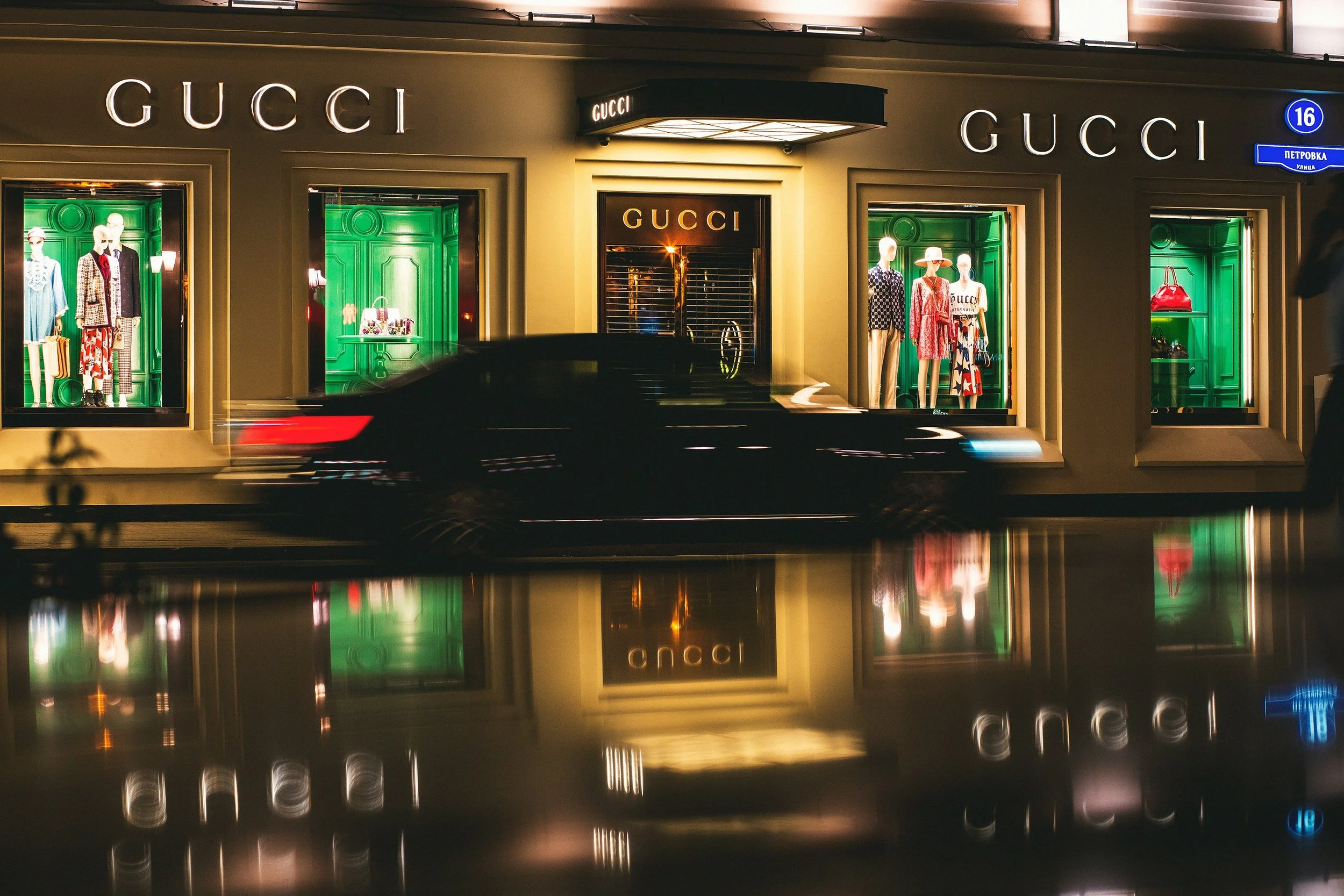
There is a number that every independent founder in luxury has heard by now. Alessandro Michele took Gucci from €3.9 billion in 2015 to €10.5 billion in 2022. Seven years. The fastest commercial turnaround in modern luxury history.
The figure gets cited as proof that the right creative director, the right aesthetic moment, the right cultural alignment, can transform a brand's entire financial trajectory.
What rarely gets cited is what Gucci's own CEO said to investors when the growth was at its most spectacular. In 2018, with revenue climbing 44 percent in a single half-year period, Marco Bizzarri stood in front of Kering's investor day and explained the distribution logic behind the numbers. "We bet, at the very beginning, for all the 500 shops we have to carry all the products Alessandro did across the board. So it was the biggest bet ever. We bet billions on this strategy, because we wanted to raise the message immediately."
Five hundred stores. The complete collection. Every door open, every product visible, the message pushed as wide and as fast as the infrastructure could carry it. And then came the philosophical reframe that justified the entire approach. Kering's analyst framing at the time described it plainly. Inclusivity, they said, was the new exclusivity.
That sentence is the distribution trap. And understanding exactly how it was set — and how Gucci walked into it — is the most useful thing an independent founder can do before pricing their first collection.
What Kering Actually Built
The Michele era did not build a luxury customer base. It built a cultural moment with luxury price points attached.
The distinction matters more than it might initially appear. A luxury customer base is defined not by who buys, but by the relationship between who buys and what that purchase signals to everyone else in the room. Hermès does not guard the Birkin waitlist because the bag would sell out without it. They guard it because access itself is the product — and once access is open to anyone willing to pay, the purchase no longer communicates what it once did. The mechanism of desire collapses.
Gucci under Michele ran the opposite logic deliberately. The brand's growth was anchored in buyers under 35, aspirational, digitally native, acutely aware of cultural currency. Fifty-five percent of Gucci's sales came from this demographic at the peak. They were not buying into Gucci's institutional heritage. They were buying into Alessandro Michele's specific vision — the gender-fluid maximalism, the eclectic Italian anachronism, the sense that this particular Gucci, at this particular cultural moment, said something true about who they were. When the Marmont appeared on every influencer, that was not a side effect of the strategy. It was the strategy made visible.
The entry-level SKUs — sneakers, hoodies, mini-bags — were the engine. They were accessible enough to reach the aspirational buyer, branded enough to carry the logo, and numerous enough to keep feeding the volume the financials demanded. The result was a brand that had built its entire growth architecture on a customer who was loyal to a creative director, not to an institution, and who was purchasing at a price point that, by the logic of luxury, should have been the floor — not the ceiling.
Kering's plan was always to use the aspirational volume as a launch mechanism and then move upmarket. The problem is that markets do not hold still while brands execute strategic repositioning.
The aspirational customer left when the cultural moment passed. The wealthy customer had never truly arrived.
There is a metric that tells this story more precisely than any revenue figure.
Sell-through rate — the percentage of inventory that moves at full price — measures not just how much a brand sells, but how much desire it commands at the price it sets. Under Michele at peak, Gucci's sell-through rate was 52 percent. Under Sabato De Sarno, attempting the repositioning Kering had always planned, it fell to 37 percent.
That collapse is not a creative failure. It is a distribution failure that preceded De Sarno's arrival by years. By the time Kering appointed a new creative director to move Gucci upmarket, the brand had already communicated — through every channel, every stockist, every gifting, every influencer placement — exactly what kind of brand it was. The customer who could have anchored a repositioned Gucci — the genuinely wealthy buyer with purchasing power that does not evaporate in a luxury downturn — had read those signals and drawn their own conclusions.
The Business of Fashion identified the structural consequence: the wealthy buyer Kering needed had never been converted, and the aspirational buyer the brand had built everything around was already gone.
That is not a summary of a bad quarter. It is the diagnosis of a distribution architecture that made a specific customer, then found it had no clear path to a different one.
Why a New Creative Director Cannot Solve a Distribution Problem
A new creative director cannot resolve this. Kering tried twice. De Sarno's quiet repositioning failed because the market did not recognize the brand he was trying to present. Demna's provocative reset is still too early to read commercially — his first full collection only hit the runway in February 2026, with product reaching stores weeks later.
What Kering is discovering, at considerable cost, is that the line Bernstein analyst Luca Solca drew is accurate: it is easier and faster for the market to believe in a revival than it is to produce one. The structural work — the distribution work — has to come first.
The Marmont is the clearest illustration of this. When Kering's CFO told investors they were very happy with the success of the reintroduction of the new Marmont, they were describing a bag the brand had spent years pushing through every channel available. The same bag they had oversaturated was now the comeback strategy. The market noticed. Not because the bag is a bad object — it is not but because the signals surrounding it had already told a specific story about who it was for, and that story does not change because the bag gets a new colorway.
Distribution is not logistics. It is the most powerful brand signal you have because it tells the market exactly who this is for before a single piece of copy runs.
Every door you open, every stockist you accept, every platform you sell through makes a statement. And those statements accumulate into a positioning that is extraordinarily difficult to walk back not because the market is unforgiving, but because the customer you attracted in response to those signals is real, and their presence in your product is now part of what other customers see when they look at the brand.
The independent founder looking at Gucci's trajectory tends to draw one of two lessons. Both miss the point.
The first: that exclusivity and scarcity are everything, and the answer is simply to do the opposite of what Gucci did, fewer stockists, higher prices, tighter access. The second: that the Michele model proves volume is accessible to luxury brands willing to embrace a broader cultural conversation, and growth at scale is simply a matter of creative ambition.
Neither of these is what the data shows.
What the data shows is that distribution is not a logistics decision. It is the most legible brand signal in the market, because it tells every observer, buyer, press, competitor, and potential customer, exactly who you have decided this brand is for. Every stockist you accept, every gifting you execute, every platform you sell through, every influencer whose hands your product appears in: each of these is a statement about the customer you are building toward. And the customers who arrive in response to those signals will either compound your positioning or constrain it, depending on whether they are the customer your second phase requires.
The question an independent founder needs to answer before pricing their first collection is not "what can I charge?" It is "whose presence in my product makes the customer I actually want more likely to come?"
The answer to that question determines not just your opening price point but your entire distribution strategy, because distribution and pricing are not separate decisions. They are the same decision made twice.
The Advantage You Have That Gucci No Longer Does
Gucci's error was not that it grew fast. It was that the mechanism of growth, the customer acquired, the channels used, the entry products scaled, made the next phase structurally harder with every quarter of success. The brand that arrives at €10.5 billion having sold primarily to aspirational buyers through maximum distribution cannot simply declare itself a different brand. The market has already decided what it is.
The independent founder's genuine advantage is that they have not made the bet yet. No channel is open, no stockist has been accepted, no gifting has gone out, no pricing has been set. The distribution architecture is still blank. That is not a problem to solve quickly. It is the only period in a brand's life when every signal can be intentional, when the founder can decide, before anyone else does, exactly what the presence of their product in the world is meant to communicate, and to whom.
The heritage houses Orisé Atelier studies, Hermès, Dior, Chanel, Bottega Veneta, did not begin by asking how to grow. They began by answering a harder question: in whose hands does this object mean something irreplaceable? The price followed from the answer. The distribution followed from the price. Everything else followed from that.
That sequencing is not a luxury available only to heritage brands. It is the only sequencing that produces one.
